
Transgender Athletes and the Law: Rights, Rulings, and Real Consequences
The legal landscape for transgender individuals in the United States has never been more contested—or more consequential. From the locker room to the courtroom, from the workplace to the rowing dock, transgender people face discrimination that carries real, lasting harm. At the same time, the legal protections designed to shield them are being actively challenged, reinterpreted, and in some cases, dismantled.
This post unpacks that tension. It examines the federal and state laws that govern transgender rights in sports and the workplace, explores how recent Supreme Court decisions are reshaping the legal landscape, and draws on a disturbing real-world case involving a teenage transgender girl in Sacramento to illustrate what’s actually at stake when legal protections fail.
Whether you are a transgender individual who has faced discrimination, an employer trying to understand your legal obligations, or someone seeking to understand your rights after being targeted in a sports program, this guide explains what the law says—and where it still falls short.
The Legal Framework: How Federal Law Protects Transgender Individuals
What does Title VII cover for transgender employees?
Title VII of the Civil Rights Act of 1964 prohibits employment discrimination on the basis of sex. For decades, courts debated whether “sex” encompassed gender identity. That debate ended—at least at the federal level—with the U.S. Supreme Court’s landmark 2020 ruling in Bostock v. Clayton County. The court held that discrimination against transgender employees constitutes sex discrimination under Title VII.
That ruling has broad implications. Employers cannot legally fire, demote, harass, or refuse to hire someone because they are transgender. Deliberately and persistently misgendering a transgender employee, excluding them from meetings, or creating a hostile work environment based on gender identity can all constitute actionable discrimination under federal law.
How does Title IX apply to transgender students and athletes?
Title IX of the Education Amendments of 1972 prohibits sex discrimination in any education program or activity receiving federal funding. Several federal courts have interpreted Title IX to protect transgender students from discrimination and harassment based on gender identity. Schools, under this framework, cannot exclude, harass, or mistreat transgender students and must respect their right to participate in activities consistent with their gender identity.
That interpretation, however, is now under significant legal pressure—particularly when it comes to sports.
The Supreme Court’s 2026 Ruling: A Turning Point for Transgender Athletes
In June 2026, the U.S. Supreme Court’s six-justice conservative majority issued a 6-3 decision upholding state laws that bar transgender girls and women from playing on school sports teams consistent with their gender identity, as reported by Chalkbeat.
The decision arose from two consolidated cases: Little v. Hecox, involving Lindsay Hecox, a transgender student who competed on a women’s club track and field team in Idaho after she didn’t qualify for the Division I team, and West Virginia v. B.P.J., involving Becky Pepper-Jackson, a transgender high school track athlete who had undergone hormone therapy from a young age.
Writing for the majority, Justice Brett Kavanaugh interpreted the term “sex” in Title IX’s sports provisions to refer exclusively to biological sex. He cited unsettled science around whether transgender women who have undergone hormone therapy retain physical advantages, and concluded that allowing transgender girls to compete on girls’ teams could place other competitors at a “serious disadvantage.”
The ruling leaves in place restrictions in 29 states, most of which explicitly bar transgender women and girls from women’s and girls’ school sports teams, according to the Movement Advancement Project. Idaho was the first state to enact such a law, in 2020.
Critically, the decision does not require states to ban transgender athletes—it permits them to do so. States like California, which allows transgender athletes to compete consistent with their gender identity, retain that right for now. But the ruling signals a future in which those inclusive policies face escalating legal and political pressure.
What did the dissenting justices say?
Justice Sonia Sotomayor dissented, questioning the majority’s cavalier treatment of transgender individuals’ rights under the Equal Protection Clause of the Fourteenth Amendment. She acknowledged that bans on transgender women and girls in female sports may not always violate Title IX, but argued that at least one of the cases—Becky Pepper-Jackson’s—warranted further fact-finding, given that Pepper-Jackson never went through male puberty.
Sotomayor also underscored the human cost of the ruling. “Sports can help build resilience, tenacity, leadership, and discipline,” she wrote. “It can lead to life-long friendships, community, and a sense of belonging… Sports, of course, are often zero sum, but the law need not and should not be.”
Workplace Discrimination Against Transgender Individuals: What It Looks Like in Practice
What are the most common forms of workplace discrimination against transgender employees?
Workplace discrimination against transgender people rarely presents as a single, obvious act. It tends to accumulate—a pattern of behavior that, taken together, creates a hostile and intolerable work environment.
Common forms include:
- Persistent misgendering: Deliberately using incorrect pronouns or names, especially after being corrected, can constitute harassment under Title VII.
- Exclusion from meetings or opportunities: Systematically leaving a transgender employee out of professional development, team discussions, or advancement opportunities.
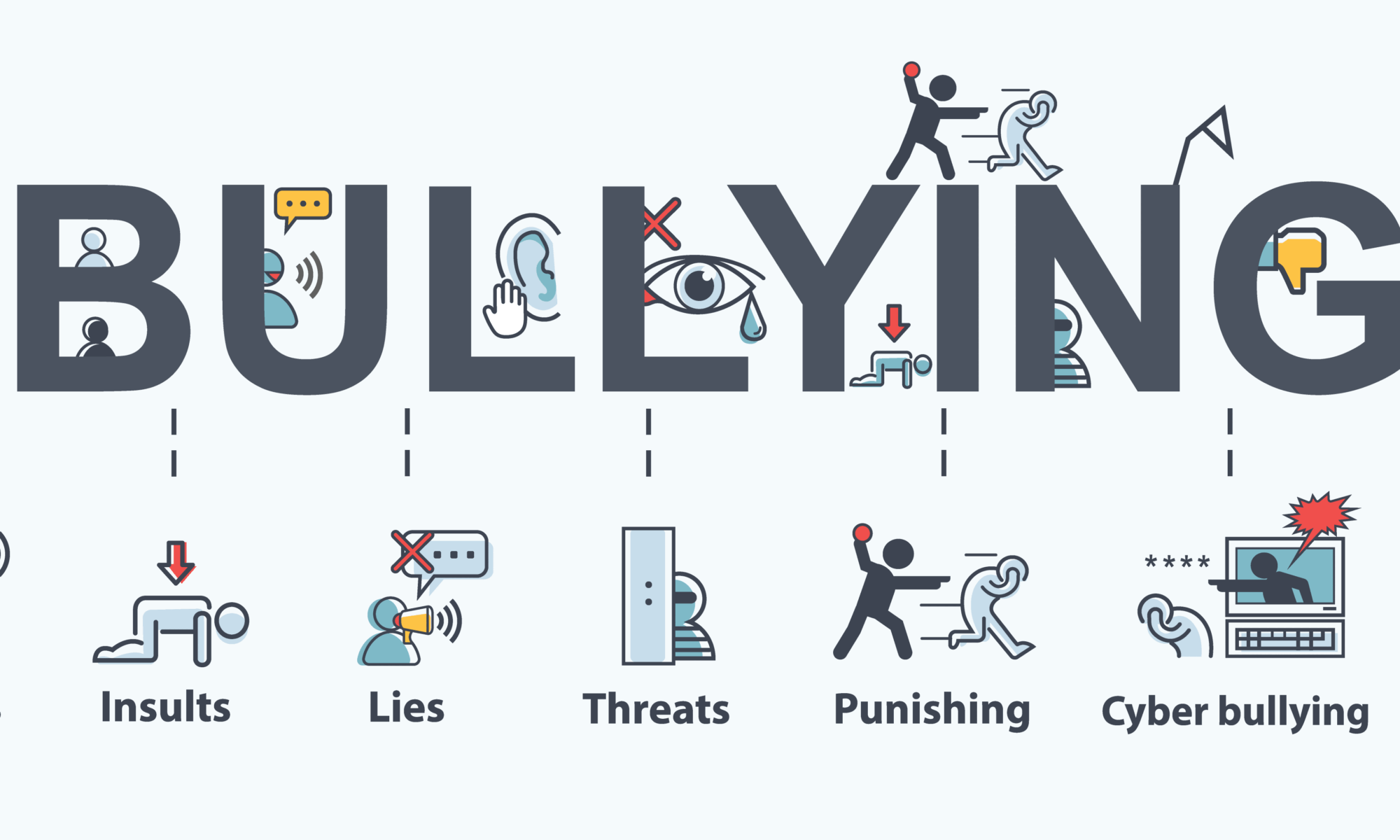
- Hostile work environment: Allowing coworkers or management to make derogatory comments, spread false rumors, or engage in targeted bullying.
- Wrongful termination: Firing an employee because of their transgender identity or because they reported discrimination.
Employers face potential liability not just for their own conduct, but for the conduct of managers and coworkers if they knew—or should have known—about the harassment and failed to act.
According to the Equal Employment Opportunity Commission (EEOC), harassment complainants filed 35,774 claims in 2024, representing an approximately 32% increase from 2022. That surge reflects growing awareness of legal rights—but also a worsening climate of discrimination.
What legal remedies are available to transgender employees?
Under Title VII, transgender employees who experience discrimination can file a complaint with the EEOC. If the agency finds merit in the claim, it can pursue conciliation or litigation on the employee’s behalf. Employees may also file a private lawsuit seeking compensatory damages, back pay, reinstatement, and attorneys’ fees. California employees have additional protections under the California Fair Employment and Housing Act (FEHA), which explicitly prohibits discrimination based on gender identity and expression and requires employers to provide reasonable accommodations for transitioning employees.
The Capital Crew Case: When Harassment Happens to a Child
Few cases illustrate the lived reality of anti-transgender discrimination more starkly than the lawsuit filed against Capital Crew, a competitive youth rowing program housed at the Sacramento State Aquatic Center.
According to a lawsuit filed in Sacramento County Superior Court, a 12-year-old transgender girl—identified by a pseudonym—endured more than two years of bullying, exclusion, and harassment at the hands of teammates and coaches. The alleged discrimination began after a parent publicly complained that she was “a boy on the girls’ team.” What followed, per the lawsuit, was systematic and relentless.
Teammates allegedly excluded her from team meetings, refused to acknowledge her presence, laughed at her, and threatened her only friend against spending time with her. Coaches, the lawsuit claims, failed to acknowledge her achievements, misgendered her, and omitted her from team selections. In January, she was allegedly separated from the rest of the team and made to practice alone on land while her teammates were on the water.
In April, a false rumor that she had inappropriately touched a teammate spread through the program. The mental health consequences were severe. According to the lawsuit, she experienced self-harm and suicidal ideation before eventually quitting the team.
The lawsuit names the coaches, Capital Crew, the Sacramento State Aquatic Center, Sacramento State, the Associated Students, Inc., and the California State University trustees. It seeks her reinstatement, the termination of the implicated coaches, an end to discrimination against transgender individuals, and compensatory damages.
Attorney Susie Cirilli, who represents the child and her mother, was unequivocal about the case’s significance. “The reason why this case is important, because at issue in this complaint, is the treatment of a child,” Cirilli said. “For over a year, this child was left unprotected while the people in charge—when not actively engaging in the hostility themselves—condoned the unlawful harassment that was being committed by the other girls on the rowing team.”
Cirilli also drew a direct line between the political climate and the harm suffered by the child. “It is important to understand that the rhetoric that is out there in the zeitgeist right now… people need to understand that it has direct effects on children.”
How does harassment in youth sports differ from workplace discrimination—and where do they overlap?
Youth sports programs like Capital Crew occupy a distinct legal space. They are not traditional employers, and participants are not employees. However, programs housed within or affiliated with institutions that receive federal funding—such as a university aquatic center—may be subject to Title IX, which prohibits sex discrimination in federally funded education programs and activities.
The legal remedies available in such cases can include reinstatement, compensatory damages, and institutional accountability measures—such as the lawsuit’s demand to strip Associated Students of its auxiliary status at Sacramento State. Organizations that fail to protect minors in their programs from harassment and discrimination face not only legal liability but significant reputational and institutional consequences.
The Gap Between Legal Protections and Lived Experience
Federal law, as it stands, provides meaningful protections for transgender employees. Bostock v. Clayton County was a watershed moment. California’s FEHA offers some of the strongest protections in the country. Yet as the Capital Crew case and the EEOC’s rising claims data both demonstrate, legal protections on paper do not automatically translate into safety in practice.
Discrimination compounds. A transgender teenager who is bullied out of a rowing program carries that experience into adulthood—into job interviews, performance reviews, and every subsequent environment where they must decide how much of themselves to reveal. The intersection of hostile rhetoric, inadequate institutional responses, and unsettled law creates conditions where discrimination can persist even where it is technically prohibited.
The Supreme Court’s 2026 sports ruling has not resolved these tensions—it has intensified them. Legal experts noted that the decision was deliberately narrow, tailored to sports and leaving many broader transgender rights questions open for future litigation. As Deborah Brake, a University of Pittsburgh law professor who has written extensively about Title IX, observed, nothing in the decision “forecloses challenges to transgender discrimination in other areas.”
Understanding Your Rights and Taking Action
The legal framework around transgender rights is evolving rapidly, and not always in a protective direction. That makes it more important than ever for transgender individuals—and their advocates—to understand what protections currently exist, where enforcement gaps remain, and when to seek legal recourse.
If you or someone you know has experienced workplace discrimination, harassment in a sports or educational program, or retaliation for reporting such conduct, the time to act is now. Legal claims are subject to statutes of limitations, and delays can affect your ability to seek justice.
Helmer Friedman LLP has represented clients in complex discrimination, harassment, and civil rights cases for over 20 years. Our attorneys understand both the legal landscape and the human cost of discrimination. If you believe your rights—or a child’s rights—have been violated, contact us for a confidential consultation. We will listen, evaluate your case honestly, and advocate fully on your behalf.