
Workplace Retaliation After Reporting Discrimination: Know Your Rights

Female advanced engineers battle discrimination.

Retaliation After Reporting Sex Discrimination

You report discrimination. You follow the rules, use the proper channels, and do everything right. Then, slowly or suddenly, your job changes. Your hours shift. Your responsibilities shrink. Or you’re fired.

This is workplace retaliation, and it happens far more often than most people realize. Retaliation is the most frequently alleged basis of discrimination in the federal sector and the most common finding in federal sector cases. The numbers bear this out: in 2024, harassment complainants filed 35,774 claims with the Equal Employment Opportunity Commission, an increase of about 32% from 2022.

For employees who have already endured discrimination, retaliation adds another layer of harm. It punishes the very act of speaking up, which is why federal and state laws treat it as a serious, independent violation. Understanding what retaliation looks like, what legal protections exist, and what steps to take can make a critical difference in protecting your rights and your career.

What Constitutes Workplace Retaliation?

Retaliation occurs when an employer takes a “materially adverse” action against an employee because that employee engaged in a protected activity—such as reporting harassment or filing a discrimination complaint. The key word is materially. Not every unpleasant interaction qualifies. A rude comment or an uncomfortable meeting typically does not meet the legal standard.

To be actionable, the employer’s conduct must be severe enough to deter a reasonable person from reporting discrimination or illegal activity in the first place.

Retaliation is not always as obvious as immediate termination. Employers sometimes use subtler tactics. Common forms include:

  • Demotion: A reduction in rank, title, pay, or responsibilities
  • Exclusion: Being left out of meetings, training sessions, or professional development opportunities
  • Shift changes: Assignment to less desirable hours or significant reduction in scheduled hours
  • Unwarranted discipline: Negative performance reviews or write-ups that contradict your actual work history
  • Hostility: Verbal abuse, intimidation, or conduct designed to make your workplace intolerable

Any of these actions, when taken in response to protected activity, can form the basis of a retaliation claim.

Legal Protections Against Workplace Retaliation

Employees who speak up about discrimination are not left without recourse. Federal and state laws provide meaningful protection.

Title VII of the Civil Rights Act

Title VII of the Civil Rights Act of 1964 is the cornerstone of federal anti-retaliation law. It prohibits employers from retaliating against employees who report discrimination based on sex, race, color, religion, or national origin. Title VII applies to public and private employers with 15 or more employees, and it covers a broad range of adverse actions, not just termination.

California’s Labor Code Section 1102.5

For California employees, state law adds an especially powerful layer of protection. Labor Code Section 1102.5 is one of the strongest whistleblower statutes in the country. It prohibits employers from retaliating against employees who report suspected violations of law to a government or law enforcement agency, or to someone in a position of authority within the organization.

Critically, California law protects you even if no actual violation occurred, provided you had a “reasonable belief” at the time of your report. This distinction matters enormously: you do not need to prove that your employer broke the law, only that you reasonably believed they did.

What Activities Are Protected Under Anti-Retaliation Laws?

Not all workplace disputes trigger legal protection. Retaliation claims require a clear link between an employee’s protected activity and the employer’s adverse action. Under federal and state law, it is illegal for an employer to retaliate against you for:

  • Reporting discrimination or harassment based on gender, race, age, or disability
  • Acting as a whistleblower regarding corporate wrongdoing or fraud
  • Refusing to engage in illegal or unethical activities
  • Complaining about wage and overtime practices
  • Taking necessary medical leave or participating in jury duty

The breadth of these protections reflects a foundational legal principle: employees must feel safe exercising their rights without fear that speaking up will cost them their livelihood.

The Dr. Haiying Huang Case: A Cautionary Tale of Workplace Retaliation

The case of Dr. Haiying Huang is a poignant reminder of the struggles many face in the workplace when retaliation rears its head. Dr. Huang joined the University of Texas at Arlington in September 2014, bringing with her a wealth of knowledge and experience as a respected faculty member in the Department of Mechanical and Aerospace Engineering. Her impressive track record included securing nearly $900,000 in grants from the U.S. Department of Defense and the Office of Naval Research to develop cutting-edge structural health monitoring sensors.

Despite her achievements, Dr. Huang encountered significant challenges. She reported that her male colleagues often undermined her authority, while her department’s leadership sided with them. Dr. Huang raised a significant concern with then-department Chair Erian Armanios: assistant professors in the department were carrying heavier teaching loads than associate and full professors. Critically, all three assistant professors at the time were foreign-born women. Seeking justice, she brought her concerns to the university’s Equal Opportunity Services office. Unfortunately, she felt that the investigation into her claims was neither thorough nor fair. Following her complaints, she was removed from her leadership positions, and her role as associate chair was given to a male colleague—a clear indication of the biases she faced.

Tragically, Dr. Huang was ultimately terminated. Feeling that her rights had been violated, she decided to take a stand and filed a lawsuit under Title VII of the Civil Rights Act, known as Huang v. University of Texas at Arlington (Case No. 4:25-cv-00181), in February 2025 in the Northern District of Texas. Early in the proceedings, Judge Mark Pittman allowed her claims of employment discrimination and retaliation to proceed to trial, rejecting the university’s attempt to dismiss the case.

During the trial, UT Arlington argued that Dr. Huang’s complaints had caused discord within the department, leading to her termination. However, her legal team, including attorneys Frank Hill and Ian Klein of Hill Gistrap, P.C., along with counsel from Cherry Johnson Siegmund James PLLC and White, Rose & Hilferty PC, challenged this reasoning, pointing out the circularity and emptiness of the justification. They asserted that it is fundamentally unjust to penalize an employee for raising legitimate concerns about discrimination.

In a powerful affirmation of Dr. Huang’s experience, the federal jury found in her favor and awarded back pay. As the court prepares for post-verdict proceedings, additional compensation for front pay and attorneys’ fees is expected. While Title VII caps non-economic damages at $300,000 for larger employers, back pay, front pay, and attorney fees are excluded from this limit, indicating that the financial implications for UT Arlington could be significant.

This verdict extends beyond Dr. Huang’s individual case; it serves as a vital signal that federal courts are willing to hold institutions accountable for retaliating against those who bravely exercise their legal rights. It is a compelling reminder of the importance of supporting those who fight workplace injustice.

Steps to Take If You Experience Workplace Retaliation

If you believe your employer is retaliating against you for reporting discrimination or engaging in any other protected activity, the actions you take in the early stages can determine the outcome of a future legal claim.

1. Document everything meticulously. Keep a detailed, contemporaneous record of every retaliatory act. Note dates, times, locations, and the names of any witnesses. Write down what was said and by whom. The more specific and timely your records, the stronger your evidence becomes.

2. Report internally through proper channels. If your employer has a formal process for reporting retaliation, use it. This creates an official paper trail showing the company was on notice. Follow up in writing wherever possible.

3. Preserve all evidence. Save copies of emails, text messages, performance reviews, and any other documentation that reflects how your treatment changed after you engaged in protected activity. A strong employment retaliation case often hinges on demonstrating that the shift in treatment was linked to your complaint.

4. Seek legal counsel from experienced employment attorneys. Retaliation cases are complex and highly fact-specific. An experienced employment attorney can help you assess whether the conduct you’ve experienced meets the legal standard, identify all applicable claims, and guide you through the process, whether that means filing with the EEOC, pursuing state claims, or proceeding to litigation.

Your Rights Are Worth Defending

Dr. Huang’s case reminds us that the law does not simply prohibit discrimination; it also prohibits punishing people for reporting it. No employee should have to choose between doing the right thing and keeping their job. Yet too many do, often without realizing that robust legal protections are in place to defend them.

The 32% increase in harassment complaints filed with the EEOC between 2022 and 2024 suggests that more employees are coming forward. Courts are listening. Juries are ruling in their favor.

If you believe you have experienced workplace retaliation after reporting sex discrimination or any other protected activity, contact Helmer Friedman LLP for a confidential consultation. With over 20 years of legal experience and more than $50 million secured in settlements and court victories, our team is ready to fight for the outcome you deserve.

Frequently Asked Questions

What is the difference between workplace retaliation and general workplace mistreatment?
Workplace retaliation has a specific legal meaning: an employer must take a materially adverse action against an employee because that employee engaged in a protected activity, such as reporting discrimination. General mistreatment, a rude manager, a difficult coworker—does not meet this standard unless it is severe enough and directly connected to protected activity.

Do I have to prove that discrimination actually occurred to file a retaliation claim?
No. Under laws like California’s Labor Code Section 1102.5, you are protected if you had a “reasonable belief” that a violation occurred when you made your report, even if that underlying violation is never proven.

How long do I have to file a retaliation claim?
Deadlines vary by jurisdiction and by the type of claim. For Title VII claims, employees typically have 180 or 300 days (depending on the state) to file a charge with the EEOC before pursuing a lawsuit. Missing these deadlines can bar your claim entirely, which is why seeking legal counsel quickly is essential.

What should I do first if I think my employer is retaliating against me?
Start documenting everything immediately—dates, incidents, communications, and any witnesses. Then consult an experienced employment attorney before taking further action. An attorney can help you preserve your rights, meet critical deadlines, and build the strongest possible case.

Vaccine Mandates & Workplace Discrimination Rights

Covid-19 exposure notification requirements.

When Public Health Meets Employee Rights: COVID-19 Vaccine Mandates and Employment Discrimination Law

COVID-19 reshaped nearly every aspect of American life. By the time the U.S. death toll reached 700,000, hospitals were overwhelmed, morgues were strained, and employers across the country were scrambling to protect their workforces. Vaccine mandates became one of the most common responses. For many companies, requiring vaccination felt like a reasonable and responsible step. For some employees, it raised urgent questions about their legal rights.

Those questions were not merely philosophical. They had real consequences: terminations, lost wages, and in some cases, lasting damage to careers and health. What emerged from this collision of public health urgency and civil rights law was a legal battleground that employment attorneys, advocacy groups, and the Equal Employment Opportunity Commission (EEOC) are still navigating today.

This post breaks down the legal framework governing vaccine mandates in the workplace, examines landmark cases, and outlines what both employees and employers need to know about religious accommodation, disability protections, and the limits of employer authority.

The Legal Framework: What Rights Do Employees Have Under Federal Law?

Two federal laws form the backbone of employee protections in vaccine mandate disputes.

Title VII of the Civil Rights Act of 1964 prohibits employment discrimination based on religion. This includes not only formal religious affiliations but also sincerely held religious beliefs and practices—even those that are personal and not tied to any organized church or denomination. Under Title VII, employers are required to provide reasonable accommodations for employees whose religious beliefs conflict with workplace policies, unless doing so would create an undue hardship on the business.

The Americans with Disabilities Act (ADA) prohibits discrimination against qualified individuals with disabilities in all aspects of employment—hiring, firing, compensation, advancement, and job training. Under the ADA, an employer must provide reasonable accommodations to employees with qualifying disabilities unless accommodation would impose significant difficulty or expense relative to the employer’s size and resources.

Critically, as EEOC Chair Andrea Lucas stated in response to the Battelle Energy Alliance settlement: “There was no pandemic exception to workers’ civil rights and liberties.” That statement carries considerable legal weight. Health emergencies do not suspend federal anti-discrimination protections.

Religious Discrimination and Vaccine Mandates

Religious discrimination in employment occurs when an employer treats an individual differently because of their religion, religious beliefs, or religious practices. This protection extends to workers who hold no religious belief at all.

Unlawful religious discrimination can take many forms. According to Helmer Friedman LLP’s religious discrimination attorneys, examples include firing an employee for missing work to observe a religious holiday, refusing to hire someone because they observe a Saturday Sabbath, or failing to accommodate a scheduling conflict rooted in faith. Apply that same logic to vaccine mandates: an employer who denies an exemption request grounded in a sincerely held religious belief—without demonstrating undue hardship—may be in violation of Title VII.

The consequences of getting this wrong can be severe. Battelle Energy Alliance, LLC (BEA), an Idaho-based engineering and consulting company, learned this the hard way. The EEOC received multiple discrimination charges alleging that BEA denied employees religious accommodations for its mandatory COVID-19 vaccine policy. The agency’s systemic investigation found reasonable cause to believe that BEA had discriminated against a class of more than 100 employees by denying accommodations for their sincerely held religious beliefs. The findings also included evidence of wrongful terminations.

BEA ultimately agreed to a $5 million settlement—without admitting guilt—to resolve these charges. The settlement required back pay, compensatory damages, and mandatory training for HR personnel. It was a costly reminder that the law does not bend to public health pressure alone.

Disability Discrimination and Vaccine Mandates

Disability discrimination protections add another critical layer to the vaccine mandate conversation. Under the ADA, a qualified employee with a disability is one who can perform the essential functions of the job with or without reasonable accommodation. Employers are legally required to explore all reasonable accommodation options before making an adverse employment decision based on disability.

Reasonable accommodations under both federal and California law can include modifying work schedules, reassigning an employee to a different position, allowing remote work, or implementing alternative health screening protocols. These are not exceptional measures—they are legal obligations.

What employers cannot do is make sweeping, blanket decisions that exclude entire categories of employees without individual assessment. As outlined by Helmer Friedman LLP’s disability discrimination attorneys, policies that automatically exclude groups of people based on a broad medical category are generally considered improper under California’s Fair Employment and Housing Act (FEHA) and federal law alike.

The ADA also restricts medical inquiries. Employers may not ask job applicants about the nature or severity of a disability, and any medical examination must be job-related and consistent with business necessity. In the context of vaccine mandates, this means that inquiries into an employee’s medical history—beyond what is strictly necessary to evaluate an accommodation request—may themselves constitute unlawful conduct.

The Battelle settlement illustrates precisely this risk. In addition to denying religious accommodations, the EEOC found that BEA had engaged in unlawful medical inquiries and denied disability accommodations to more than 100 employees. Both categories of conduct contributed to the $5 million resolution.

The Battelle Energy Alliance Case: A Watershed Moment

The BEA case deserves close attention because of what it reveals about the legal exposure facing employers who prioritize mandate compliance over accommodation obligations.

BEA is a research, engineering, and consulting company headquartered in Idaho Falls, Idaho. When the company implemented a mandatory COVID-19 vaccine policy, employees who sought religious or disability-based exemptions alleged they were denied, subjected to unlawful medical questioning, and in some cases, terminated.

The EEOC’s investigation, initiated in part through a 2021 commissioner’s charge filed by EEOC Chair Andrea Lucas, found reasonable cause to believe systemic discrimination had occurred. The resulting three-year conciliation agreement required BEA to:

  • Provide back pay to aggrieved employees
  • Pay compensatory damages
  • Fund mandatory HR training on religious and disability accommodation policies
  • Resolve all outstanding individual and systemic charges

The total value of the settlement: $5 million.

The message this sends to employers is unambiguous. A sincere belief—whether religious or medical—does not disappear because a public health crisis exists. Accommodation obligations remain intact.

What Employers Must Know Before Denying an Accommodation Request

Employers retain the right to implement health and safety policies, including vaccine mandates. But that right comes with legal guardrails.

Before denying an accommodation, employers must demonstrate genuine undue hardship—not mere cost or inconvenience. Under the ADA, undue hardship is defined as an action requiring significant difficulty or expense relative to the employer’s size, financial resources, and operational structure. A large corporation with extensive resources faces a much higher threshold than a small business with limited staffing options.

Practical alternatives that may constitute reasonable accommodations include:

  • Medical or religious exemptions from vaccination requirements
  • Regular COVID-19 testing as an alternative to vaccination
  • Remote work arrangements where the role permits
  • Modified schedules to reduce exposure risk

Documentation matters enormously. Employers should maintain clear records of every accommodation request received, the interactive process followed, and the reasoning behind any denial. Proper record-keeping protects the organization in the event of an EEOC investigation or litigation.

Training HR personnel is not optional—it is, as the Battelle settlement demonstrates, something the EEOC may require as a condition of resolution.

What Employees Should Do If Their Accommodation Is Denied

Employees who believe their religious beliefs or disabilities were not properly accommodated have meaningful legal options—but acting early and deliberately is essential.

Document everything in writing. Submit accommodation requests formally and keep copies. If a request is made verbally, follow up with an email summarizing the conversation. A written record is critical evidence if the matter escalates.

Track employer responses. Note dates, the names of individuals involved, and the substance of any denials or delays. Unexplained silences can be legally significant.

Understand your rights. Title VII and the ADA establish federal protections. California employees may have additional protections under the FEHA, which applies to employers with five or more employees—a lower threshold than the ADA’s 15-employee minimum.

Consult an employment attorney. If an accommodation request is denied or ignored, speaking with an experienced employment discrimination attorney can clarify whether the denial was lawful and what options are available. Many attorneys, including those at Helmer Friedman LLP, offer confidential case evaluations.

File a charge with the EEOC. Employees who believe they have been discriminated against can file a charge of discrimination with the EEOC. This step is typically required before pursuing a federal lawsuit and triggers a formal investigation.

Civil Rights Don’t Pause for Public Health Crises

Vaccine mandates raised legitimate workplace health concerns. Employers had a genuine interest in protecting their employees, their clients, and their operations. That interest, however valid, did not override the legal obligations they owed to workers with sincerely held religious beliefs or qualifying disabilities.

The Battelle Energy Alliance settlement—$5 million, mandatory training, back pay, and compensatory damages for more than 100 employees—stands as a concrete reminder of what happens when those obligations are ignored. It is not an isolated outcome. The EEOC has made clear that enforcement in this area remains a priority.

For employees who were denied accommodations, terminated, or subjected to unlawful medical inquiries during the pandemic, the window to seek justice may still be open. The law was on your side then. It remains on your side now.

If you believe you were denied a religious or disability accommodation during the COVID-19 pandemic, contact Helmer Friedman LLP for a confidential consultation. Our employment discrimination attorneys have over 20 years of experience representing employees across the country—and we are ready to advocate for you.

Can my employer legally mandate a COVID-19 vaccine?
Yes, in most jurisdictions, employers can implement mandatory vaccine policies. However, they are legally required to provide reasonable accommodations to employees with sincerely held religious beliefs or qualifying disabilities under Title VII and the ADA, absent undue hardship.

What counts as a sincerely held religious belief for accommodation purposes?
A sincerely held religious belief does not need to be affiliated with a recognized religion or denomination. It can be personal and deeply held, provided it is genuinely religious in nature rather than a personal preference or political opinion. Employers cannot interrogate the validity of a belief, only whether it is sincere.

What should I do if my employer denied my accommodation request without explanation?
Document the denial immediately—in writing if possible. Consult an employment attorney to assess whether the denial was lawful. If it was not, you may have grounds to file a charge with the EEOC or pursue legal action.

How long do I have to file a discrimination claim with the EEOC?
In most states, employees have 180 days from the date of the discriminatory act to file a charge with the EEOC. In states with their own anti-discrimination agencies—including California—that window extends to 300 days. Acting promptly is critical.

What is “undue hardship,” and how does it affect my accommodation request?
Undue hardship is the legal standard an employer must meet to lawfully deny an accommodation. It requires demonstrating significant difficulty or expense, factoring in the employer’s size and financial resources. Minor inconvenience or cost alone does not meet this standard.

Kroger Pays $75K in Disability Discrimination Case

Disability discrimination after breast cancer treatment requires reasonable accommodations.

Kroger Pays $75K After Ghosting Employee Requiring Reasonable Accommodation

A breast cancer survivor asked for a stool. She got silence instead.

That silence—spanning months of unanswered calls, canceled shifts, and corporate indifference—cost The Kroger Co. $75,000 and a federal lawsuit. For employers across the country, this case is more than a cautionary tale. It’s a blueprint for exactly what not to do when an employee requests a disability accommodation.

Here’s what happened, why it violated federal law, and what every employer needs to understand before they make the same mistake.

Kroger grocery store sign.

What Happened at Kroger’s Atlanta Store

The employee in question was hired as a cashier at a Kroger location in Atlanta’s Edgewood retail district. Her medical history was significant: she had survived breast cancer, but the treatment left her with permanent nerve damage to her lower extremities. Standing for extended periods wasn’t just uncomfortable—it was a genuine medical issue.

Her request was straightforward. She asked to sit on a stool or chair during her shifts and backed it up with supporting medical documentation. Simple. Reasonable. Documented.

Kroger’s response? The store stopped scheduling her entirely.

Over the following weeks, she called repeatedly. No one answered. No one called back. She filed an internal complaint with the company. Still nothing. Months passed without a single scheduled shift.

In July 2023, she notified Kroger that she had filed a charge of disability discrimination with the Equal Employment Opportunity Commission (EEOC). The company’s response this time was swift—but not in the way she needed. Kroger informed her that any further communication would need to go through her attorney and their legal team. From that point forward, the company made no attempt to contact her or schedule her to work.

In short: she reported discrimination, and Kroger went silent for good.

Why This Conduct Violates the ADA

The Americans with Disabilities Act (ADA) is federal law. It prohibits employers with 15 or more employees from discriminating against qualified individuals with disabilities in hiring, firing, compensation, training, or any other term or condition of employment.

Critically, the ADA doesn’t just ban outright discrimination. It requires employers to provide reasonable accommodations for qualified employees with disabilities—unless doing so would create an “undue hardship,” defined as significant difficulty or expense given the employer’s size, resources, and operational structure.

A stool. For a cashier. At a national grocery chain with billions in annual revenue.

The idea that seating for a cancer survivor with nerve damage would constitute “undue hardship” for Kroger doesn’t hold up to scrutiny.

Reasonable accommodations under the ADA can include:

  • Modified job duties to reduce physical strain
  • Schedule adjustments to accommodate medical appointments
  • Work area changes, such as providing seating or relocating a workstation
  • Reassignment to a vacant position better suited to the employee’s needs
  • Mechanical or equipment aids to support the employee’s function

What the law does not permit: ignoring accommodation requests, cutting off an employee’s hours without explanation, and then going completely dark after an EEOC charge is filed.

That last part is where the retaliation claim comes in. The ADA explicitly prohibits retaliation against any employee who requests an accommodation, files an internal complaint, or pursues a discrimination charge with the EEOC. Kroger’s decision to cease all contact after learning of the EEOC filing crossed that legal line clearly and directly.

Why Employers Keep Getting This Wrong

Cases like this one aren’t flukes. They reflect patterns of misunderstanding—and in some instances, willful disregard—that appear across industries.

Misconception 1: Future risk or cost justifies inaction. Some employers hesitate to accommodate disabled workers out of concern that doing so will raise insurance premiums or create ongoing operational issues. Under both the ADA and California’s Fair Employment and Housing Act (FEHA), these are not legally acceptable reasons to deny accommodation or discriminate.

Misconception 2: “Reasonable” means optional. The word “reasonable” in the ADA doesn’t give employers room to simply decline without exploring alternatives. The law requires a genuine, good-faith effort to find a workable solution before any denial is considered.

Misconception 3: Silence isn’t retaliation. Cutting off shifts and communication in the weeks and months following an accommodation request—and then going fully silent after an EEOC charge—is retaliation. It doesn’t require a termination letter or an explicit threat. The pattern of conduct is enough.

Misconception 4: Poor procedures are just an internal problem. When accommodation requests aren’t documented, tracked, or responded to in a timely way, employers lose their ability to demonstrate good-faith compliance. That absence of documentation becomes evidence.

The Settlement and What Kroger Agreed to Do

The EEOC filed suit in the U.S. District Court for the Northern District of Georgia (EEOC v. The Kroger Co., Case No. 1:25-cv-00272). The case was resolved through a two-year consent decree that includes:

  • $75,000 in monetary relief paid to the former cashier
  • Updated complaint procedures within the company
  • Specialized training for store leaders and HR personnel who handle disability accommodation requests
  • Workplace notices informing employees of the settlement and their right to be free from discrimination
  • Periodic EEOC reporting on how accommodation requests are received and handled

Marcus G. Keegan, regional attorney for the EEOC’s Atlanta District, was direct in his assessment: “When an employee requests reasonable accommodations for their disability or files a complaint of discrimination, their employer cannot simply ignore them.”

Darrell E. Graham, director of the EEOC’s Atlanta District, added: “Employers cannot shirk their legal obligations under the ADA.”

The settlement is both a financial penalty and a corrective framework—one that Kroger is now legally obligated to follow and report on.

What Every Employer Should Take Away From This Case

This case distills into a set of obligations that apply to every employer covered by the ADA—which includes any business with 15 or more employees.

Respond promptly and in writing. When an employee submits an accommodation request, acknowledge it quickly and document every step of the process. Silence is not neutral—it’s potential evidence of neglect or retaliation.

Engage in an interactive process. The ADA expects a good-faith dialogue between employer and employee to identify workable solutions. This isn’t optional. Skipping it and simply denying a request—or worse, quietly pulling someone off the schedule—creates significant legal exposure.

Take retaliation risk seriously. Any adverse action taken against an employee after they request an accommodation, file an internal complaint, or contact the EEOC is legally dangerous territory. This includes scheduling changes, reduced hours, demotion, or simply going silent.

Train your people. Store managers, HR personnel, and frontline supervisors need to understand what the ADA requires. Without training, well-intentioned employees can still make legally costly decisions.

Build real procedures. Accommodation requests need a clear intake process, documented responses, and escalation paths. If your organization lacks these, you’re operating without a safety net.

The Cost of Looking Away

Disability discrimination cases carry more than a dollar figure. There’s the reputational damage. The EEOC reporting obligations. The court-mandated training. The public settlement notice posted in the workplace itself.

For this particular employee—a breast cancer survivor who asked for nothing more than a chair—the harm was deeply personal. She provided medical documentation. She followed the process. She made phone calls that were never returned. She went months without income or communication from a company that had hired her and then, for all practical purposes, pretended she didn’t exist.

The ADA was designed precisely for situations like this one. And the EEOC’s enforcement of it sends a clear signal: accommodation obligations aren’t suggestions, and retaliation isn’t a viable strategy.

If you or someone you know has been denied reasonable workplace accommodations, had shifts cut after filing a complaint, or experienced retaliation following an EEOC charge, you may have legal recourse. Contact Helmer Friedman LLP for a confidential disability discrimination consultation. Our disability discrimination attorneys have over 20 years of experience advocating for employees whose rights have been violated—and we’re here to help you understand your options.

Transgender Athletes, Discrimination Law & Your Rights

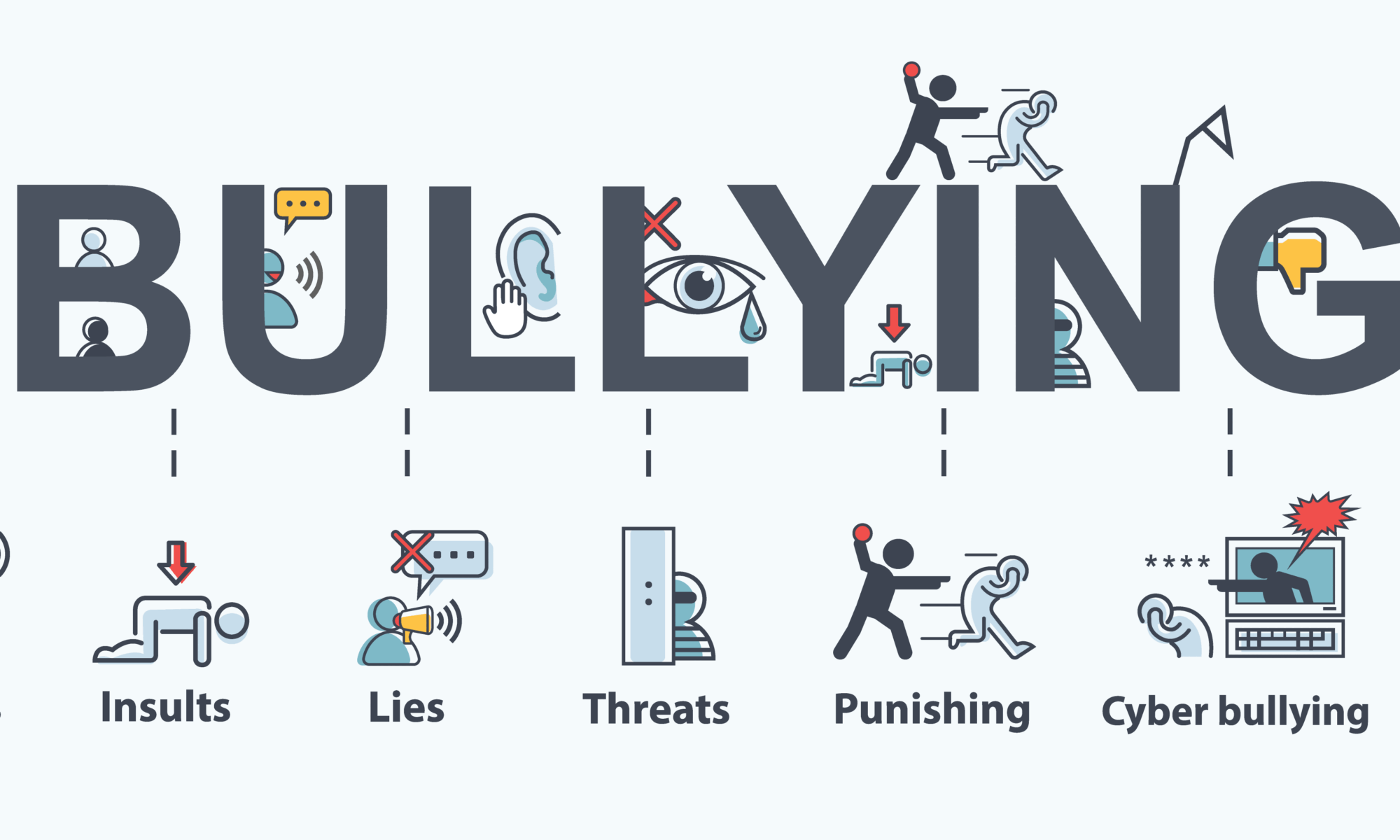
Hostile Work Environment | Workplace bullying attorneys Helmer Friedman LLP.

Transgender Athletes and the Law: Rights, Rulings, and Real Consequences

The legal landscape for transgender individuals in the United States has never been more contested—or more consequential. From the locker room to the courtroom, from the workplace to the rowing dock, transgender people face discrimination that carries real, lasting harm. At the same time, the legal protections designed to shield them are being actively challenged, reinterpreted, and in some cases, dismantled.

This post unpacks that tension. It examines the federal and state laws that govern transgender rights in sports and the workplace, explores how recent Supreme Court decisions are reshaping the legal landscape, and draws on a disturbing real-world case involving a teenage transgender girl in Sacramento to illustrate what’s actually at stake when legal protections fail.

Whether you are a transgender individual who has faced discrimination, an employer trying to understand your legal obligations, or someone seeking to understand your rights after being targeted in a sports program, this guide explains what the law says—and where it still falls short.

The Legal Framework: How Federal Law Protects Transgender Individuals

What does Title VII cover for transgender employees?

Title VII of the Civil Rights Act of 1964 prohibits employment discrimination on the basis of sex. For decades, courts debated whether “sex” encompassed gender identity. That debate ended—at least at the federal level—with the U.S. Supreme Court’s landmark 2020 ruling in Bostock v. Clayton County. The court held that discrimination against transgender employees constitutes sex discrimination under Title VII.

That ruling has broad implications. Employers cannot legally fire, demote, harass, or refuse to hire someone because they are transgender. Deliberately and persistently misgendering a transgender employee, excluding them from meetings, or creating a hostile work environment based on gender identity can all constitute actionable discrimination under federal law.

How does Title IX apply to transgender students and athletes?

Title IX of the Education Amendments of 1972 prohibits sex discrimination in any education program or activity receiving federal funding. Several federal courts have interpreted Title IX to protect transgender students from discrimination and harassment based on gender identity. Schools, under this framework, cannot exclude, harass, or mistreat transgender students and must respect their right to participate in activities consistent with their gender identity.

That interpretation, however, is now under significant legal pressure—particularly when it comes to sports.

The Supreme Court’s 2026 Ruling: A Turning Point for Transgender Athletes

In June 2026, the U.S. Supreme Court’s six-justice conservative majority issued a 6-3 decision upholding state laws that bar transgender girls and women from playing on school sports teams consistent with their gender identity, as reported by Chalkbeat.

The decision arose from two consolidated cases: Little v. Hecox, involving Lindsay Hecox, a transgender student who competed on a women’s club track and field team in Idaho after she didn’t qualify for the Division I team, and West Virginia v. B.P.J., involving Becky Pepper-Jackson, a transgender high school track athlete who had undergone hormone therapy from a young age.

Writing for the majority, Justice Brett Kavanaugh interpreted the term “sex” in Title IX’s sports provisions to refer exclusively to biological sex. He cited unsettled science around whether transgender women who have undergone hormone therapy retain physical advantages, and concluded that allowing transgender girls to compete on girls’ teams could place other competitors at a “serious disadvantage.”

The ruling leaves in place restrictions in 29 states, most of which explicitly bar transgender women and girls from women’s and girls’ school sports teams, according to the Movement Advancement Project. Idaho was the first state to enact such a law, in 2020.

Critically, the decision does not require states to ban transgender athletes—it permits them to do so. States like California, which allows transgender athletes to compete consistent with their gender identity, retain that right for now. But the ruling signals a future in which those inclusive policies face escalating legal and political pressure.

What did the dissenting justices say?

Justice Sonia Sotomayor dissented, questioning the majority’s cavalier treatment of transgender individuals’ rights under the Equal Protection Clause of the Fourteenth Amendment. She acknowledged that bans on transgender women and girls in female sports may not always violate Title IX, but argued that at least one of the cases—Becky Pepper-Jackson’s—warranted further fact-finding, given that Pepper-Jackson never went through male puberty.

Sotomayor also underscored the human cost of the ruling. “Sports can help build resilience, tenacity, leadership, and discipline,” she wrote. “It can lead to life-long friendships, community, and a sense of belonging… Sports, of course, are often zero sum, but the law need not and should not be.”

Workplace Discrimination Against Transgender Individuals: What It Looks Like in Practice

What are the most common forms of workplace discrimination against transgender employees?

Workplace discrimination against transgender people rarely presents as a single, obvious act. It tends to accumulate—a pattern of behavior that, taken together, creates a hostile and intolerable work environment.

Common forms include:

  • Persistent misgendering: Deliberately using incorrect pronouns or names, especially after being corrected, can constitute harassment under Title VII.
  • Exclusion from meetings or opportunities: Systematically leaving a transgender employee out of professional development, team discussions, or advancement opportunities.
  • Hostile work environment: Allowing coworkers or management to make derogatory comments, spread false rumors, or engage in targeted bullying.
  • Wrongful termination: Firing an employee because of their transgender identity or because they reported discrimination.

Employers face potential liability not just for their own conduct, but for the conduct of managers and coworkers if they knew—or should have known—about the harassment and failed to act.

According to the Equal Employment Opportunity Commission (EEOC), harassment complainants filed 35,774 claims in 2024, representing an approximately 32% increase from 2022. That surge reflects growing awareness of legal rights—but also a worsening climate of discrimination.

What legal remedies are available to transgender employees?

Under Title VII, transgender employees who experience discrimination can file a complaint with the EEOC. If the agency finds merit in the claim, it can pursue conciliation or litigation on the employee’s behalf. Employees may also file a private lawsuit seeking compensatory damages, back pay, reinstatement, and attorneys’ fees. California employees have additional protections under the California Fair Employment and Housing Act (FEHA), which explicitly prohibits discrimination based on gender identity and expression and requires employers to provide reasonable accommodations for transitioning employees.

The Capital Crew Case: When Harassment Happens to a Child

Few cases illustrate the lived reality of anti-transgender discrimination more starkly than the lawsuit filed against Capital Crew, a competitive youth rowing program housed at the Sacramento State Aquatic Center.

According to a lawsuit filed in Sacramento County Superior Court, a 12-year-old transgender girl—identified by a pseudonym—endured more than two years of bullying, exclusion, and harassment at the hands of teammates and coaches. The alleged discrimination began after a parent publicly complained that she was “a boy on the girls’ team.” What followed, per the lawsuit, was systematic and relentless.

Teammates allegedly excluded her from team meetings, refused to acknowledge her presence, laughed at her, and threatened her only friend against spending time with her. Coaches, the lawsuit claims, failed to acknowledge her achievements, misgendered her, and omitted her from team selections. In January, she was allegedly separated from the rest of the team and made to practice alone on land while her teammates were on the water.

In April, a false rumor that she had inappropriately touched a teammate spread through the program. The mental health consequences were severe. According to the lawsuit, she experienced self-harm and suicidal ideation before eventually quitting the team.

The lawsuit names the coaches, Capital Crew, the Sacramento State Aquatic Center, Sacramento State, the Associated Students, Inc., and the California State University trustees. It seeks her reinstatement, the termination of the implicated coaches, an end to discrimination against transgender individuals, and compensatory damages.

Attorney Susie Cirilli, who represents the child and her mother, was unequivocal about the case’s significance. “The reason why this case is important, because at issue in this complaint, is the treatment of a child,” Cirilli said. “For over a year, this child was left unprotected while the people in charge—when not actively engaging in the hostility themselves—condoned the unlawful harassment that was being committed by the other girls on the rowing team.”

Cirilli also drew a direct line between the political climate and the harm suffered by the child. “It is important to understand that the rhetoric that is out there in the zeitgeist right now… people need to understand that it has direct effects on children.”

How does harassment in youth sports differ from workplace discrimination—and where do they overlap?

Youth sports programs like Capital Crew occupy a distinct legal space. They are not traditional employers, and participants are not employees. However, programs housed within or affiliated with institutions that receive federal funding—such as a university aquatic center—may be subject to Title IX, which prohibits sex discrimination in federally funded education programs and activities.

The legal remedies available in such cases can include reinstatement, compensatory damages, and institutional accountability measures—such as the lawsuit’s demand to strip Associated Students of its auxiliary status at Sacramento State. Organizations that fail to protect minors in their programs from harassment and discrimination face not only legal liability but significant reputational and institutional consequences.

The Gap Between Legal Protections and Lived Experience

Federal law, as it stands, provides meaningful protections for transgender employees. Bostock v. Clayton County was a watershed moment. California’s FEHA offers some of the strongest protections in the country. Yet as the Capital Crew case and the EEOC’s rising claims data both demonstrate, legal protections on paper do not automatically translate into safety in practice.

Discrimination compounds. A transgender teenager who is bullied out of a rowing program carries that experience into adulthood—into job interviews, performance reviews, and every subsequent environment where they must decide how much of themselves to reveal. The intersection of hostile rhetoric, inadequate institutional responses, and unsettled law creates conditions where discrimination can persist even where it is technically prohibited.

The Supreme Court’s 2026 sports ruling has not resolved these tensions—it has intensified them. Legal experts noted that the decision was deliberately narrow, tailored to sports and leaving many broader transgender rights questions open for future litigation. As Deborah Brake, a University of Pittsburgh law professor who has written extensively about Title IX, observed, nothing in the decision “forecloses challenges to transgender discrimination in other areas.”

Understanding Your Rights and Taking Action

The legal framework around transgender rights is evolving rapidly, and not always in a protective direction. That makes it more important than ever for transgender individuals—and their advocates—to understand what protections currently exist, where enforcement gaps remain, and when to seek legal recourse.

If you or someone you know has experienced workplace discrimination, harassment in a sports or educational program, or retaliation for reporting such conduct, the time to act is now. Legal claims are subject to statutes of limitations, and delays can affect your ability to seek justice.

Helmer Friedman LLP has represented clients in complex discrimination, harassment, and civil rights cases for over 20 years. Our attorneys understand both the legal landscape and the human cost of discrimination. If you believe your rights—or a child’s rights—have been violated, contact us for a confidential consultation. We will listen, evaluate your case honestly, and advocate fully on your behalf.

Protecting Healthcare Workers from Resident Harassment

Medical care, hospital - Family Leave Lawyers Helmer Friedman LLP.

When Residents Become Harassers: Protecting Healthcare Workers

Sexual harassment in healthcare is rarely discussed the way it deserves to be. It doesn’t always come from a supervisor or a colleague. Sometimes, it comes from the very patients and residents that staff are paid to care for. And when facilities fail to act, the consequences—for workers, for organizations, and for justice—can be severe.

A recent federal settlement makes this reality impossible to ignore. Christian Care Management, Inc. (CCMI), which operates six Fellowship Square senior living facilities across Arizona, agreed to pay $250,000 to settle a sexual harassment lawsuit filed by the U.S. Equal Employment Opportunity Commission (EEOC). The case exposed a pattern of abuse, institutional negligence, and preventable harm that no healthcare worker should ever endure.

The Scope of the Problem in Healthcare Settings

Sexual harassment in healthcare is far more common than most people realize. According to the American Nurses Association, more than 1 in 4 nurses—27%—report experiencing sexual harassment on the job, frequently from patients or their family members. Facility-wide, harassment claims have surged significantly: the EEOC recorded 35,774 harassment complaints in 2024, representing an approximately 32% increase from 2022 (EEOC, 2024).

Harassment in healthcare takes many forms:

  • Verbal abuse: Inappropriate comments, sexual jokes, suggestive remarks, or degrading language directed at staff
  • Physical contact: Unwanted touching, grabbing, or assault
  • Non-verbal conduct: Leering, suggestive gestures, or exposure
  • Quid pro quo situations: When employment benefits or job security are tied to sexual compliance
  • Third-party harassment: Misconduct from patients, residents, visitors, or contractors

Each of these forms is illegal. Each causes real harm. And each demands a real response.

What Happened at Fellowship Square: A Case Study in Institutional Failure

The CCMI case is a sobering example of what happens when management looks the other way.

According to the EEOC’s lawsuit, multiple female employees at the Fellowship Square location in Mesa, Arizona, were repeatedly subjected to sexual harassment by male residents. The conduct included requests for sexual favors, directing inappropriate sexual language at staff, and sitting in their underwear while housekeeping employees cleaned their rooms.

The female employees reported the harassment to management. Management did nothing meaningful. No notifications were sent to human resources. No adequate steps were taken to stop the escalation.

Then things got worse.

Despite multiple documented reports about one particular resident’s inappropriate behavior toward female staff, management assigned a female employee to drive that resident to an appointment—placing her alone in a vehicle with him. During the drive, the resident grabbed her breast and private parts while exposing himself.

What followed was a case study in what an employer should never do. According to the EEOC suit, the company denied her request to take the day off after the assault. It then waited four days to initiate a psychological evaluation of the resident and another 13 days before beginning the eviction process.

“Sexual harassment in any workplace, no matter the harasser, is illegal and violates federal civil rights law,” said Mary Jo O’Neill, regional attorney for the EEOC’s Phoenix District. “Employers have a legal duty to prevent, investigate, and eliminate sexual harassment any time it occurs.”

The Legal and Organizational Consequences of Inaction

The CCMI case is not an outlier—it’s a warning.

Title VII of the Civil Rights Act of 1964 prohibits sexual harassment in the workplace and applies to employers with 15 or more employees. Under Title VII, harassment by residents, patients, or any non-employee can still create employer liability when the organization knew about the conduct and failed to act promptly and appropriately.

EEOC Senior Trial Attorney Karl Tetzlaff put it plainly: “There is no acceptable amount of sexual harassment. Companies should investigate and adequately respond to all complaints in order to prevent a continuing escalation of unlawful sexually harassing behavior.”

The cost of inaction extends well beyond a settlement check. Healthcare facilities that fail to protect their workers face:

  • Costly litigation and settlements, as the CCMI case demonstrates
  • Regulatory scrutiny and compliance violations that trigger ongoing oversight
  • Reputational damage that erodes patient trust and drives talent away
  • Diminished patient care quality, as staff distracted by harassment or trauma cannot perform at their best
  • Increased employee turnover, compounding already severe workforce shortages in healthcare

Best Practices for Protecting Healthcare Workers from Resident Harassment

Prevention is both a legal obligation and a moral one. The following measures represent the standard of care for any healthcare or senior living facility serious about worker safety.

Establish and Enforce Zero-Tolerance Policies

A written harassment policy is the starting point, not the finish line. Policies must clearly define what constitutes harassment—including harassment from residents—outline confidential reporting procedures, and specify consequences for violations. These policies should be actively enforced, not filed away.

Critically, resident handbooks should also include anti-harassment expectations. Under the CCMI consent decree, CCMI is required to include an anti-sexual harassment policy in its resident handbook. That should be standard practice across the industry.

Provide Mandatory, Regular Staff Training

Training should go beyond a one-time orientation video. Effective sexual harassment prevention training covers real-world scenarios specific to healthcare settings, teaches bystander intervention strategies, and informs staff of their legal rights. Leadership and management must participate too—the tone at the top matters.

Create Confidential Reporting Channels

Many harassment victims stay silent out of fear of retaliation or disbelief. Facilities must establish anonymous and confidential reporting systems—dedicated hotlines, secure email channels, or access to an independent HR or compliance officer. A clear, fair, and documented complaint process protects both the employee and the organization.

Investigate Every Complaint Promptly

Delayed investigations compound harm. As seen in the CCMI case, days of inaction after a serious assault allowed continued risk and deepened the organization’s liability. Every complaint must trigger an immediate, thorough, and documented response.

Take Swift Corrective Action—Including Removal

When a resident’s conduct crosses a legal or safety threshold, management must act decisively. That may mean restricting a resident’s access to certain staff, issuing formal warnings, requiring behavioral assessments, or initiating eviction proceedings. The safety of employees cannot be subordinated to operational convenience.

Support Affected Employees

Workers who experience harassment or assault deserve more than a return to regular duties. Counseling resources, temporary reassignments, and accommodations can make a critical difference in recovery and retention. Denying a victim’s request for a day off after an assault—as alleged in the CCMI case—is not just callous; it may constitute further legal exposure.

A Culture of Accountability Starts at the Top

Strong policies and good training only work when leadership is genuinely committed. Healthcare executives, administrators, and department heads must allocate resources for training and investigations, hold all employees accountable regardless of rank, and treat every complaint as serious. The alternative—ignoring reports, delaying action, or hoping problems resolve themselves—carries consequences that no facility can afford, legally or ethically.

Healthcare Workers Deserve Better

The $250,000 settlement paid by CCMI represents more than a financial penalty. It represents the real cost of ignoring a problem that was reported, documented, and preventable at every stage.

Healthcare workers—nurses, housekeeping staff, aides, and administrators—perform some of the most demanding and vital work in our society. They deserve workplaces that protect them. Facilities that fail that obligation don’t just risk lawsuits. They risk everything.

If you or someone you know has experienced sexual harassment in a healthcare or senior living facility and management failed to respond appropriately, you may have legal recourse. Contact Helmer Friedman LLP for a confidential consultation to understand your rights.


Frequently Asked Questions

Can a healthcare employer be held liable for harassment by a patient or resident?

Yes. Under Title VII of the Civil Rights Act of 1964, employers can be held legally responsible for harassment perpetrated by non-employees—including patients and residents—if the employer knew or should have known about the conduct and failed to take prompt, appropriate corrective action.

What should I do if I experience harassment from a patient or resident at work?

Report the incident to your supervisor or HR department immediately and document the details in writing. If management does not respond adequately, you have the right to file a complaint with the EEOC. You may also consult an employment attorney to discuss your legal options.

What counts as sexual harassment under federal law?

Title VII defines sexual harassment as unwelcome sexual advances, requests for sexual favors, and other verbal or physical conduct of a sexual nature that affects employment conditions, interferes with work performance, or creates a hostile work environment. This includes harassment from patients, residents, visitors, and co-workers.

What should healthcare facilities include in their anti-harassment policies?

An effective policy should define prohibited conduct, include procedures for reporting complaints, outline investigation steps, specify consequences for violations, and offer support resources for affected employees. Resident-facing policies—such as those in resident handbooks—should also set clear behavioral expectations.

Can I be fired or retaliated against for reporting sexual harassment?

Retaliation against an employee for reporting harassment is illegal under federal and state law. If you face negative employment consequences after filing a complaint, that itself may constitute a separate legal violation. Document any retaliatory actions and consult an attorney promptly.